A dog barks at the window. Lunges toward another dog on-leash. Pees on the floor when visitors arrive. Growls at a server at a restaurant.
Suddenly, we have a list of things to fix. And we feel like every item is a top-priority emergency.
Humans tend to turn every imperfection of their dog into a training need. But before something goes on the training list, it’s worth stepping back to ask: Is it actually a behavior problem? Is it a safety concern? Is it a sign the dog is genuinely struggling? Or is it simply a behavior we wish were different?
The answer shapes what we choose to work on, and how much we expect from our dogs.
Who decides what counts?
In 2024, a headline-grabbing study from Texas A&M University analyzed owner survey data from over 43,000 dogs in the Dog Aging Project and reported that more than 99% of U.S. dogs had at least one "moderate-to-serious" behavior problem.
If you think that statistic makes it sound like every dog in America is in crisis, you aren't alone. Researchers at the University of Pennsylvania reanalyzed the exact same dataset and arrived at drastically lower numbers.
Why the massive gap? It came down to how behaviors were defined and grouped.
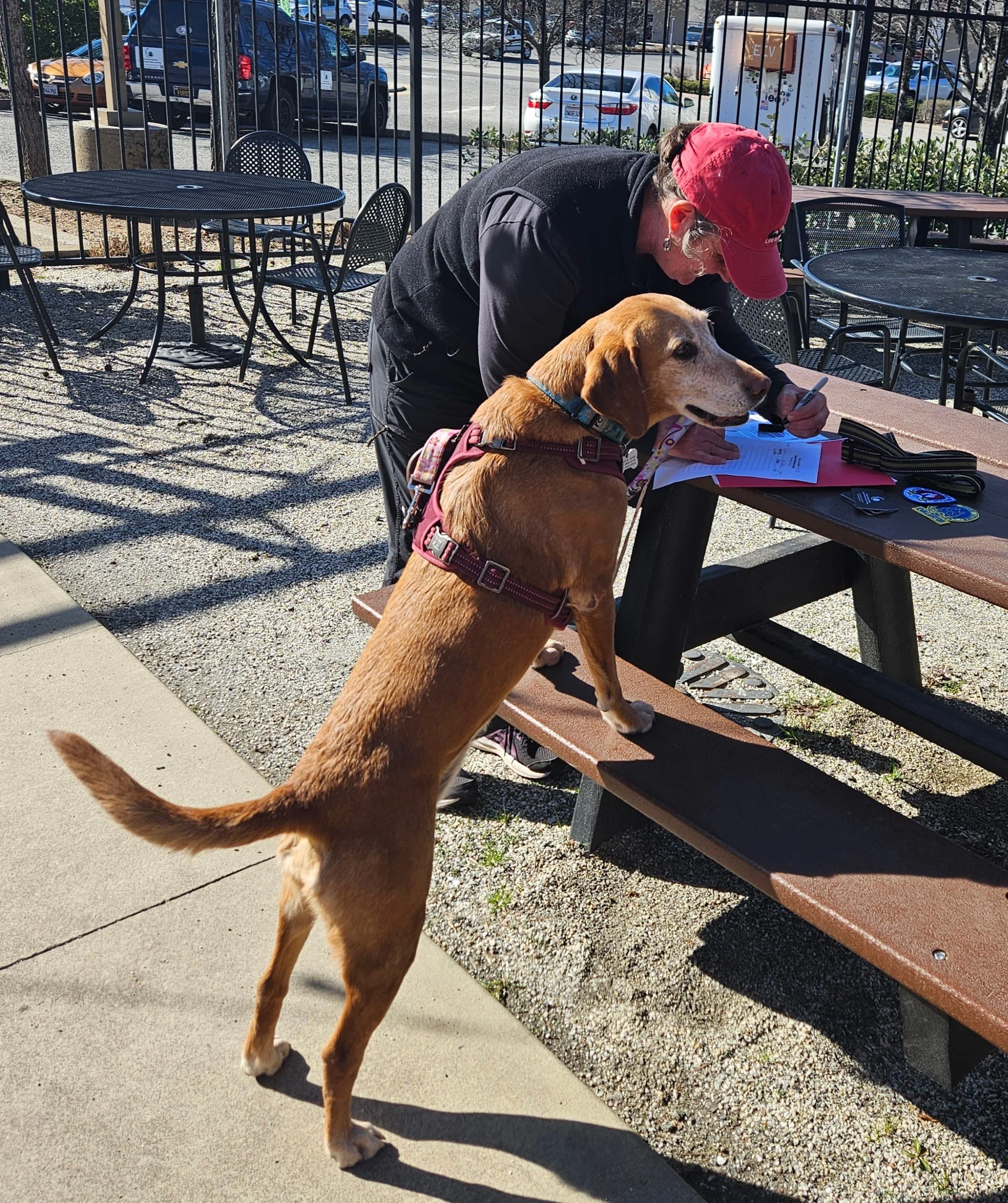
Would putting paws up on a bench be the behavior you’re looking for or present a problem? P.S. we think Maggie is pretty awesome.
Lumping companionship with panic
A major driver of the 99% statistic was combining two entirely different traits: separation-related behavior and attachment/attention-seeking.
When the UPenn team evaluated the two categories separately, the picture changed completely:
88.9% of dogs scored high for typical attachment and attention-seeking habits (like following owners from room to room or sitting close by).
Only 9.3% of dogs actually fell into the moderate-to-serious range for true separation-related distress.
In other words, a dog who follows you to the bathroom and a dog who panics when you leave are not the same dog. In this group, nearly 90% of dogs wanted to be in the same room as their human, while fewer than 10% suffered from separation distress. Lumping "velcro" companionship in with severe anxiety mislabels a normal, loving canine trait as a disorder.
The threshold problem: what counts as aggression?
The survey’s rating scale also created false alarms. Under the original study’s cutoff, a dog growling at an approaching delivery worker would count as showing “moderate aggression”. The UPenn researchers argued that alert growling is functional canine communication rather than a clinical disorder. But, in daily life, many owners do experience growling or alert barking as a problem — which is why it drives so many calls to behavior professionals.
When researchers raised the threshold to screen for higher severity, such as snapping or biting, the percentages dropped significantly:
Separation distress: Dropped from 9.3% to 2.3%.
Dog-directed aggression: Dropped from 30.4% to 11.0%.
Fear of strangers: Dropped to 4.2%.
The distinction matters: behavioral surveys like the mini C-BARQ measure how often and how intensely a dog does something. That doesn’t necessarily tell us whether the behavior is actually a problem for the dog or the people living with them.
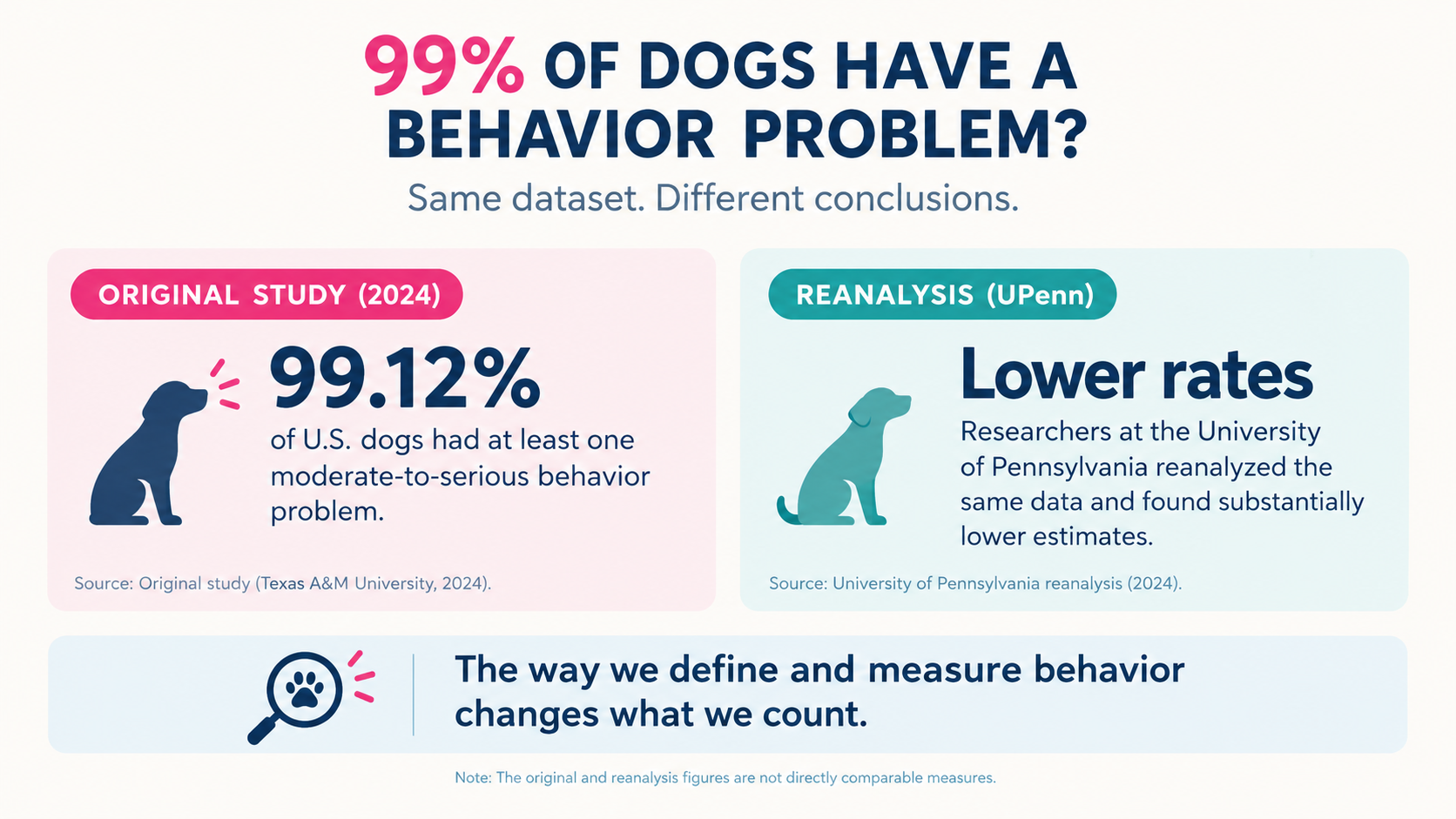
Infographic comparing a 2024 study reporting 99.12% of U.S. dogs had behavior problems with a University of Pennsylvania reanalysis finding substantially lower rates.
Being a dog isn't a disorder
Neither study settles the exact percentage of dogs with behavior problems, but the debate proves something vital: what counts as a "problem" depends heavily on how we define one.
Mislabeling normal, species-typical behavior as a "disorder" creates unnecessary stress for dog owners. A dog who is clingy, vocal, alert, or curious isn't broken—they’re just being a dog.
Before you add another item to your training list, ask yourself if your dog is truly struggling, or if they’re simply expressing their nature in a human world.
Not everything needs to be fixed
The behavior itself doesn't tell us everything. Context, frequency, intensity, and how the dog is coping all matter.
Consider four dogs:
Barking at the window can range from ordinary alerting to significant distress.
Following someone around can be normal companionship or part of a larger separation-related issue.
Growling is communication, but the context and circumstances matter.
Difficulty being alone can range from mild frustration to serious distress.
Those aren’t interchangeable problems, and they don’t have the same implications. To sort out what deserves your time and energy, it helps to categorize behavior into four distinct levels:
Normal but inconvenient. The door barker. The shadow following you room to room. This is typical dog behavior. Perhaps annoying and possibly worth managing, but not a sign of a broken dog or a reason for a mandatory training program.
Understandable but potentially unsafe. A growl is communication, and a valuable one. It tells you the dog is uncomfortable, and that deserves attention before the dog feels they have to say it louder.
A sign the dog isn’t coping. A dog in distress when left alone isn’t being inconvenient. They are genuinely struggling and need support.
Interferes with the dog’s ability to function. When behavior keeps a dog from resting, eating, or moving safely through daily life, intervention isn’t optional.
Some behaviors need to be understood. Some need to be managed or accommodated. Some need to change. What differs is how urgent each one is and how much is at stake for the dog. Sometimes the most useful thing a professional does is help you see which category you’re in. Without that clarity, we end up treating everyday life like an endless list of homework assignments.
Making room to notice progress

Split image showing two ways to celebrate progress: a person relaxing on a bench with their dog, and a person playing tug with their dog. The PAWS Training Cycle appears below, with Celebrate highlighted.
Training rarely has a finish line. There’s always another skill to polish, another environment to practice in, or another distraction to proof against.
That’s why the last step of the PAWS Training Cycle (Reframe, Manage, Train… Celebrate) matters so much. Celebrate is the built-in pause. It asks you to reflect on:
What’s easier now?
What can your dog do today that they couldn’t before?
What situations have become more manageable?
What have you learned to handle differently?
What’s good enough for the life you actually live?
Celebrating doesn’t mean the work is permanently finished. It means acknowledging progress instead of immediately moving the goalposts.
Because maybe the most important question isn’t “What else does my dog need to learn?”
It’s “What does my dog need to be able to do to live successfully in the world we share?”
That’s a much more useful standard than perfect behavior.
References
Beaver, B. V. (2024). The prevalence of behavior problems in dogs in the United States. Journal of Veterinary Behavior, 76, 34–39. https://doi.org/10.1016/j.jveb.2024.11.001
Serpell, J. A., & Powell, L. R. (2025). Prevalence and severity of behavior problems in dogs in the United States: A re-assessment. Journal of Veterinary Behavior. https://doi.org/10.1016/j.jveb.2025.11.00
Casa Luna Canines is your partner in dog training, human learning. Join us to learn how to be your dog’s best friend using 100% pain and fear free methods. Imagine what it will feel like when your dog chooses to behave well around you, no matter where you are!